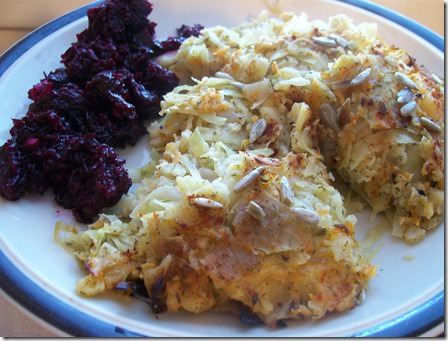
Solyanka from moosewood

100_7921notes: I made a few changes due to what was in the kitchen.  Less cottage cheese though close to 1.5 c. that was all I had, more cabbage than 4 c. but not much more, 1/2 c sour cream as it’s full fat and I would have felt guilty using a whole cup, no sunflower seeds as mine were dead, was going to use 1/2 c of ricotta but it was 6 months out of date.  I sprinkled paprika over the top even though I’m not a big fan.

4 Medium Potatoes
4 Packed Cups Shredded Green Cabbage
1½ cups Chopped Onion
3 Tbsp Butter
1½ tsp Salt
Black Pepper
Paprika
½ tsp Dill Weed
¼ cup Sunflower Seeds, divided
1½ cups Cottage Cheese
½ cup Sour Cream
½ cup ricotta
2 Tbsp Cider Vinegar

Scrub, don’t peel, the potatoes and cut them into small pieces. Boil until mashable. Drain and mash, while still hot, with cottage cheese, sour cream and yogurt. Saute onions in butter with 1/2 tsp. salt. After 5 minutes, add cabbage and remaining salt. Saute until cabbage is tender. Combine with potato mixture, and add everything except 2 tablespoons of the sunflower seeds and the paprika. Taste to correct seasonings. Spread into a deep, buttered casserole and top with paprika and remaining sunflower seeds. Bake at 350 degrees, uncovered for 35-40 minutes.
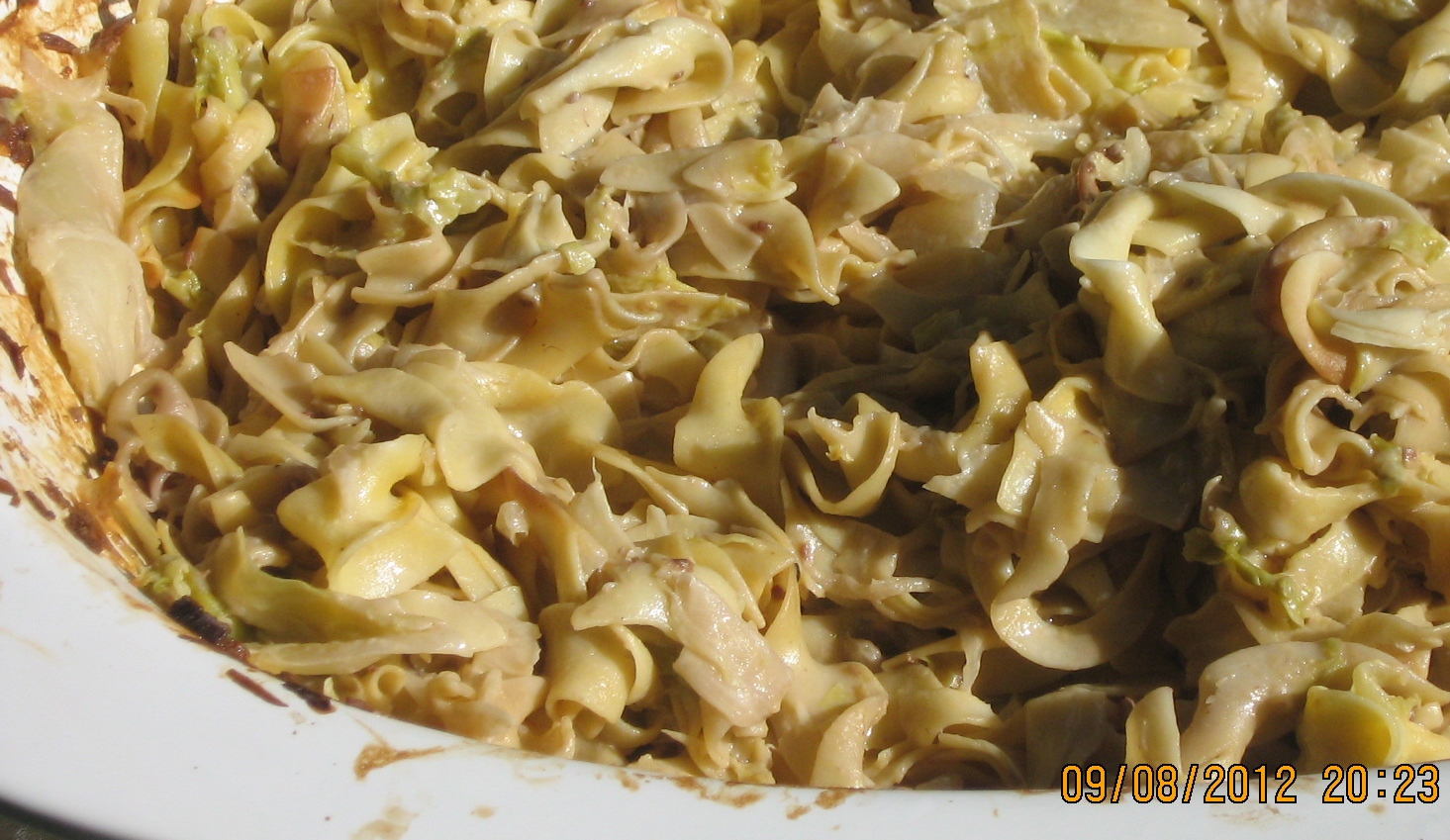
Mushroom Noodle Pudding

noodle-kugel1

2 tbsp butter or vegetable oil
2 scallions, minced
1 small onion, minced
16 ounces firm, fresh mushrooms, stemmed, halved, and sliced
1/4 cup mushroom broth or white wine
Salt and freshly ground pepper, to taste
1 cup cottage cheese
½ cup sour cream
1/4 c. mild cheese, grated
2 large eggs, beaten
pinch paprika
pinch dill
4 c. cooked cooked pasta, penne or ziti or regular noodles
2 tbsp. chopped parsley

Preheat oven to 350ºF.

Heat butter or oil in a large skillet over medium-low heat. Add onion and scallions, sauté 10 minutes or until very tender. Add mushrooms, salt, pepper,  sauté 10 minutes until mushrooms are tender and limp. If liquid remains in pan, cook over high heat, stirring, 2 minutes until it evaporates.   Add broth or wine and simmer for 5 min.

Cook noodles uncovered in a large pan of boiling salted water over high heat 4 minutes or until nearly tender but firmer than usual. Transfer to a large bowl.

In mixing bowl add beat eggs, cottage cheese, sour cream and cheese, transfer mushroom mixture to bowl. Stir in paprika, dill, parsley and noodles.

Grease an 8″  baking dish and add noodle mixture. Bake until firm and golden brown, about 45 minutes. Makes 4 to 6 servings.


Apple Sharlotka by Matt Dano

IMG_7709

  • 4 apples—peeled, cored, quartered and thinly sliced
  • 1 tablespoon fresh lemon juice
  • 1 cup sugar
  • 3/4 cup plus 2 tablespoons all-purpose flour
  • 1/4 teaspoon ground cinnamon
  • 1/4 teaspoon freshly grated nutmeg
  • Pinch of kosher salt
  • 3 large eggs
  • 1/2 teaspoon pure almond extract
  • Confectioners’ sugar, for dusting
  1. Preheat the oven to 350°. Grease the bottom and side of an 8-inch springform pan.
  2. In a large bowl, toss the apples with the lemon juice and 2 tablespoons of the sugar and let stand for 15 minutes.
  3. Meanwhile, in a small bowl, whisk the flour with the cinnamon, nutmeg and salt. In a medium bowl, using an electric mixer, beat the eggs with the almond extract and the remaining 3/4 cup plus 2 tablespoons sugar at medium-high speed until thick and pale yellow and a ribbon forms when the beaters are lifted, 8 to 10 minutes. Gently fold in the dry ingredients just until incorporated.
  4. Spread the apples in the prepared pan in an even layer, then pour the batter evenly over them. Let stand for 5 minutes to allow the batter to sink in a little.
  5. Bake the sharlotka for about 1 hour, until it is golden and crisp on top and a cake tester inserted in the center comes out clean. Transfer to a rack and let rest for 15 minutes. Unmold and transfer to a serving platter. Dust with confectioners’ sugar and serve warm.


salmon bibimbap from http://thewoksoflife.com/

salmon-bibimbap-10

2 cups raw white rice
light olive oil or canola oil
2 carrots, julienned
Salt and pepper
2 cups bean sprouts
2 bunches watercress
4 cloves garlic, minced
1 tablespoon soy sauce
1 teaspoon toasted sesame seeds
½ teaspoon sesame oil
1 salmon steak or filet
4 eggs, cooked sunny side up (over easy is fine too)
1 cup kimchi
Roasted seaweed flakes or sheets, cut into slivers (optional)
Gochujang paste, to taste (about 1-2 tablespoons per serving)

First, cook 2 cups of dry rice using your preferred method.

Next, heat a pan with 1 tablespoon of oil over medium-high heat. Stir-fry the carrots for about 1 minute, sprinkling with a pinch of salt. Transfer to a bowl and set aside.

Next, stir fry the bean sprouts using the same method as with the carrots.

Next prep your watercress. Cut each bunch in half and wash thoroughly.

In the same pan you used for the carrots, heat 2 tablespoons of oil over medium high heat. Add the garlic and let fry gently for about 15-20 seconds. Add the watercress, followed by a ½ teaspoon of salt, and stir-fry until completely wilted. Remove from the heat and toss with the soy sauce, sesame seeds, and sesame oil. Set aside.

Now for the salmon. Sprinkle with salt and pepper on both sides. Heat a pan over medium high heat with 3 tablespoons of oil. Add the salmon. Let brown for about 5 minutes. Flip, and let the other side cook for another 5 minutes. Our salmon steak was pretty thick, so cooking time may need to be adjusted depending on how big your piece of salmon is. When in doubt, just use a knife to gently cut into the center to check for doneness. Looks don’t matter with this dish, as we’ll be flaking the salmon anyway.

While the salmon is cooking, set aside the kimchi and seaweed flakes, cutting up the seaweed with kitchen shears if you’re using roasted sheets. Also, cook one egg for each person you’re serving.

When the salmon is finished cooking, you’re ready to assemble your bibimbap.

Spoon a nice bed of rice into a bowl and top with a small handful of flaked salmon and your egg. Add as much watercress, carrot, bean sprouts, kimchi, and seaweed as your heart desires. Finish off with gochujang to taste. Stir thoroughly and enjoy with a big spoon!

Beer-glazed salmon with roasted mushrooms from whole foods

  • 2 pounds mixed mushrooms (such as shiitake, cremini or oyster) , thickly sliced
  • 2 shallots , sliced4918-1 (1)
  • 5 sprigs fresh thyme
  • 2 tablespoons extra-virgin olive oil
  • 1/2 teaspoon coarse sea salt , divided
  • 1/2 teaspoon ground black pepper , divided
  • 3/4 cup stout beer
  • 2 tablespoons firmly packed light brown sugar
  • 1 tablespoon Dijon mustard
  • 4 skinless, boneless salmon fillets
  • Preheat the oven to 400°F.In a large bowl, combine mushrooms, shallots and thyme sprigs. Drizzle with oil, season with 1/4 teaspoon of the salt and 1/4 teaspoon of the pepper and toss to combine. Arrange mushrooms in a single layer on a large rimmed baking sheet. Roast, stirring 2 or 3 times, until nicely browned, about 45 minutes. Let cool slightly.

    Meanwhile, in a small heavy saucepan, stir together beer, brown sugar and mustard and bring to a boil. Reduce heat and simmer until mixture just starts to thicken, 5 to 8 minutes. Remove from heat and set glaze aside. (Reserve all but 1/4 cup of the glaze for serving.)

    Pat fish dry and season with remaining 1/4 teaspoon salt and 1/4 teaspoon pepper. Place skin-side down in a large baking dish. Toss mushrooms with 2 tablespoons of the glaze and spoon them around fish. Brush fish with additional 2 tablespoons of the glaze. Roast until fish is just cooked through and flakes easily, 10 to 12 minutes. Serve each piece of fish with a generous portion of mushrooms and reserved glaze on the side.

  •  

    Creamy smoked salmon pasta with dill from whole foods

    • 189610 ounces dried linguine
    • 1 tablespoon extra virgin olive oil
    • 1 tablespoon butter
    • 1 shallot , finely chopped
    • 1/2 cup dry white wine (or 2 tablespoons lemon juice in 1/4 cup water)
    • 3/4 cup half and half
    • 1 cup frozen peas
    • 1 package smoked salmon , cut into thin strips
    • 1/4 cup finely chopped fresh dill
    • Salt and pepper to taste
    • Lemon wedges
    Cook pasta according to package directions. While pasta is cooking, heat oil and butter in a large sauté pan over medium high heat. Sauté shallots 2 to 3 minutes until softened. Add white wine and simmer until reduced by half, another 2 to 3 minutes. Reduce heat, add half and half and peas and gently simmer 2 to 3 minutes more before adding salmon and dill. Heat through and let sauce thicken slightly. Drain pasta and toss in pan with sauce to coat. Season with salt and pepper and a squeeze of fresh lemon juice. Serve immediately.


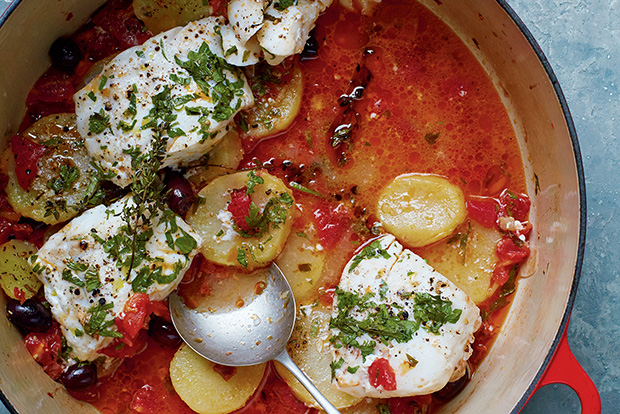
    Cod en Cocotte with tomatoes and olives from epicurious.com

    56390077

    • 2 medium Yukon Gold potatoes (12 ounces/350 g total)
    • 6 plum tomatoes, peeled, seeded, and chopped
    • 1 1/2 ounces (45 g) Spanish chorizo, cut into 1/8-inch (3-mm) dice (OMIT)
    • 12 small black olives, such as Niçoise, pitted
    • 1 large garlic clove, chopped
    • Four 4- to 5-ounce (125- to 150-g) skinned cod fillets
    • 4 thyme sprigs
    • 1/4 cup (8 g) chopped parsley
    • 4 tablespoons (60 g) unsalted butter, sliced
    • 3 tablespoons extra-virgin olive oil
    • 2 tablespoons fresh lemon juice
    • Sea salt and freshly ground pepper
     Heat the oven to 350°F (175°C). In a medium saucepan of boiling water, cook the potatoes until tender, about 20 minutes. Drain and let cool slightly, then peel and cut into slices 1/4 inch (6 mm) thick.

    In a medium enameled cast-iron casserole, spread the potato slices, tomatoes, chorizo, olives, and garlic. Set the fish on top and add the thyme, parsley, butter, oil, and lemon juice. Season with salt and pepper. Cover and bring to a simmer on the stove, then transfer the pot to the oven and cook until the fish is just opaque throughout, 10 to 15 minutes. Serve directly from the casserole.

    Make Ahead
    The casserole can be assembled and refrigerated for up to 4 hours before baking.


    Cauliflower Cake from plenty more

    51254830

    • 1 small cauliflower, outer leaves removed, broken into 1 1/4-inch/3-cm florets (1 pound/450 g)
    • 1 medium red onion, peeled (6 ounce/170 g)
    • 5 tablespoons/75 ml olive oil
    • 1/2 teaspoon finely chopped rosemary
    • 7 eggs (scant 1 pound/440 g)
    • 1/2 cup/15 g basil leaves, chopped
    • 1 cup/120 g all-purpose flour, sifted
    • 1 1/2 teaspoons baking powder
    • 1/3 teaspoon ground turmeric
    • 5 ounces/150 g coarsely grated Parmesan or another mature cheese
    • Salt and black pepper
    • Melted unsalted butter, for brushing
    • 1 tablespoon white sesame seeds
    • 1 teaspoon nigella seeds
    • Preheat the oven to 400°F/200°C.

      Place the cauliflower florets in a saucepan and add 1 teaspoon salt. Cover with water and simmer for 15 minutes, until the florets are quite soft. They should break when pressed with a spoon. Drain and set aside in a colander to dry.

      Cut 2 round slices off one end of the onion (each 1/4 inch/5 mm thick) and set aside. Coarsely chop the rest of the onion ( if it’s strong only use half of the onioln) and place in a small pan with the oil and rosemary. Cook for 10 minutes over medium heat, stirring from time to time, until soft. Remove from the heat and set aside to cool. Transfer the onion to a large bowl, add the eggs and basil, whisk well, and then add the flour, baking powder, turmeric, Parmesan, 1 teaspoon salt, and plenty of pepper. Whisk until smooth before adding the cauliflower and stirring gently, trying not to break up the florets.

      Line the base and sides of a 9 1/2-inch/24-cm spring-form cake pan with parchment paper. Brush the sides with melted butter, then mix together the sesame and nigella seeds and toss them around the inside of the pan so that they stick to the sides. Pour the cauliflower mixture into the pan, spreading it evenly, and arrange the reserved onion rings on top. Place in the center of the oven and bake for 45 minutes, until golden brown and set; a knife inserted into the center of the cake should come out clean. Remove from the oven and leave for at least 20 minutes before serving. It needs to be served just warm, rather than hot, or at room temperature.


    Best Tomato Soup Ever from Ree Drumond

    WU0508H_best-tomato-soup-ever-recipe_s4x3.jpg.rend.snigalleryslide.landscape1 medium white or yellow onion
    6 tablespoons (3/4 stick) butter
    Two 14.5-ounce cans diced tomatoes
    One 46-ounce bottle or can tomato juice
    3 to 6 tablespoons sugar
    1 or 2 tablespoons veggie base
    Freshly ground black pepper
    1 cup sherry, optional
    1 1/2 cups heavy cream
    1/4 cup chopped fresh basil
    1/4 cup chopped flat-leaf parsley

    To begin, dice the onion. Melt the butter in a large pot or Dutch oven. Throw in the onion and cook until translucent.

    Now dump in the diced tomatoes and stir to combine. Add the tomato juice.

    Next – and this is important – in order to combat the acidity of the tomatoes add 3 to 6 tablespoons of sugar. Now, you’ll want to start on the low side, then taste and add more as needed. Some tomatoes and juice have more of an acidic bite than others. (For what it’s worth, and I realize it’s not worth much, I use 6 tablespoons of sugar.)

    Next, add 1 or 2 tablespoons chicken base to the pot. I added 3, and it wound up being a little too much.

    Now you can add lots of freshly ground black pepper. Stir to combine, then heat almost to a boil. Then turn off the heat.

    Add in the sherry if desired. Stir in the cream. Add the basil and parsley and stir.

    Serve the soup warm!

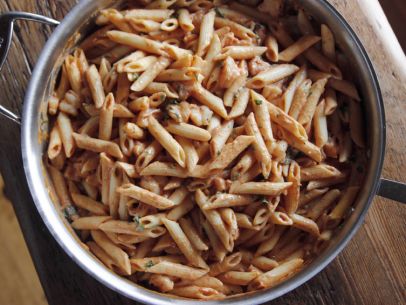
    Penne Alla Betsy from Ree Drumond

    WU0506H_penne-alla-betsy-recipe_s4x3.jpg.rend.sni12col.landscapeSalt
    1 pound penne pasta
    1 1/2 pounds large shrimp
    2 tablespoons butter
    2 tablespoons olive oil
    2 cloves garlic, finely chopped
    1 small onion, finely chopped
    1/2 cup white wine, optional
    Two 14.5-ounce cans tomato sauce
    1 cup heavy cream
    1/4 cup chopped fresh flat-leaf parsley
    6 leaves fresh basil, cut in chiffonade
    Milk, for thinning
    Freshly ground black pepper
    Crusty French bread, for serving

    Bring a pot of lightly salted water to a boil. Cook the penne until al dente (firm yet tender). Drain and set aside.

    Begin by peeling and deveining the shrimp and rinsing them under cold water.

    In a large skillet over medium-high heat, add 1 tablespoon of the butter and 1 tablespoon of the olive oil. When the pan is hot, add the shrimp. Stir and cook on both sides until just starting to turn opaque, about 2 minutes. Remove to a plate and allow to cool slightly.

    In a large skillet over medium heat, add the remaining 1 tablespoon butter and 1 tablespoon olive oil. Add the garlic and onion. Stir to combine and cook, stirring occasionally, until the onion is translucent, about 3 minutes.

    Pour the wine into the pan if using. Stir and allow it to evaporate, about 45 seconds. Pour in the tomato sauce and stir to combine. Reduce the heat to low. Pour in the cream. Mmmm. Stir well to combine; reduce the heat to simmer.

    And now for the fun part: remove the tails from the shrimp, chop the shrimp into medium-size pieces and add them to the sauce. Stir gently to combine.

    Next, dump in the parsley and basil and stir. Add the cooked, drained pasta. Stir gently to coat. If the sauce is too thick, splash in a little milk to get it to the right consistency. Add salt and freshly ground black pepper. Be sure to taste the seasonings at the end, adjusting if necessary.

    Serve directly out of the skillet, or pour the contents of the skillet into a pretty serving bowl. Serve with crusty French bread – and more wine.

    Read more at: http://www.foodnetwork.com/recipes/ree-drummond/penne-alla-betsy-recipe.html?oc=linkback