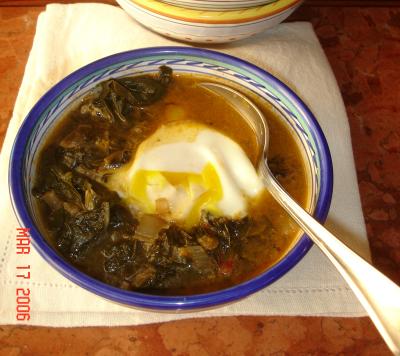
Alma’s Cooked Water Soup, Lidia

2 pounds Swiss chaalma's_cooked_water_soup_851_frd
1 onion, chopped
2 stalks celery , trimmed, peeled and cut in chunks
⅓ cup Italian parsley
8 fresh basil leaves
⅓ cup extra-virgin olive oil
½ teaspoon peperoncino
1 tablespoon tomato paste
9 cups water
2 teaspoons salt
¼ teaspoon freshly ground black pepper
eggs, (1 for each serving of soup)
day-old country bread, (1/2 a slice)
pecorino, freshly grated

Wash and drain the chard and tear out the long stems from the leafy parts. Stack the leaves and slice crosswise into 1-inch strips. Cut off the tough base of each stem and discard. Chop the trimmed stems into 1/2-inch pieces.

Using a food processor, mince the onion, celery, parsley, and basil into a fine textured paste (pestata). Heat the oil in the saucepan over medium heat, scrape in the pestata and stir it all around the pan as it starts to steam and sizzle. Sprinkle in the peperoncino and cook, stirring, until the pestata has dried and starts to stick, 4 minutes or so. Drop in the tomato paste, and stir to toast it for a minute.

Pour in the water, raise the heat to high, and stir up all the cooked seasonings, while adding 2 teaspoons of salt and freshly ground pepper to taste.

Bring the water to the boil and dump in all of the cut chard leaves and chopped stems. Return to the boil, cover partially and cook at a steady simmer for about 40 minutes, until the chard is very tender and the broth is quite flavorful. Turn off the heat until you’re ready to serve.

For each portion, ladle about 1 1/3 cups of soup into the skillet. Heat to a simmer; crack and carefully slip into the soup one egg for each serving. Turn the heat down very low, cover the skillet tightly, and poach the eggs for 2 minutes or longer. Put a bread slice or croutons in each warm soup bowl, and when the eggs are done as you like them, lift them out, one at a time, with a slotted spoon or spatula, taking some cooked greens too. Lay the egg and greens on the bread and ladle in hot broth to cover. Sprinkle pecorino over the egg and broth, and serve immediately, passing more cheese at the table.

– See more at: http://www.lidiasitaly.com/recipes/detail/851#sthash.F17C3DBN.dpuf
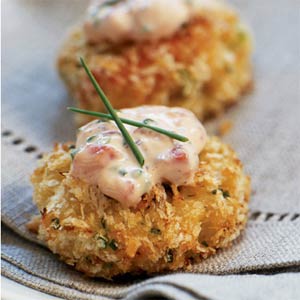
Panko-crusted Crab Cake Bites with Roasted Pepper-Chive Aioli

from myrecipes.com/
crab-cakes-su-656208-x

12 ounces shelled cooked crab
1/4 cup finely diced celery
1/4 cup minced fresh chives
1/4 cup mayonnaise
1 large egg
2 teaspoons Dijon mustard
1/4 teaspoon hot sauce
1 1/4 cups panko (see notes) or fine dried bread crumbs
Roasted Pepper-Chive Aioli (recipe follows)
Fresh chives, rinsed and cut into 1-inch lengths

1. Sort through crab and discard any bits of shell.

2. In a large bowl, combine celery, minced chives, mayonnaise, egg, mustard, and hot sauce; mix well with a fork. Add crab and 1/4 cup panko; stir gently just to mix.

3. Put remaining 1 cup panko in a shallow bowl. Shape crab mixture into 24 cakes, each about 2 inches wide and 1/2 inch thick. Turn each cake in panko to coat on all sides, pressing gently to make crumbs adhere. Place cakes slightly apart in an oiled 12- by 17-inch baking pan.

4. Bake in a 475° regular or convection oven until golden brown, 15 to 18 minutes. With a spatula, transfer crab cakes to a platter. Spoon a dollop of Roasted Pepper-Chive Aioli onto each cake. Garnish platter with fresh chives. Serve hot.

Roasted Pepper-Chive Aioli. In a small bowl, mix 1/3 cup mayonnaise, 1/4 cup chopped drained canned roasted red peppers, 1 tablespoon minced fresh chives, 2 teaspoons lemon juice, and 1 teaspoon minced garlic. Makes about 1/2 cup.

Notes: The Japanese-style coarse bread crumbs called panko are available in many well-stocked supermarkets and in Asian grocery stores. You can make the aioli up to 2 days ahead and the crab cakes through step 3 up to 4 hours ahead; in both cases, cover and chill.

Cauliflower Patties from food52

  • cauliflower1 large cauliflower (washed & trimmed into bite size pieces)
  • 3 to 4 shallots, peeled and chopped
  • 2 to 3 small garlic cloves (peeled and finely chopped)
  • 3 to 4 large organic eggs
  • Fresh italian flat leaf parsley
  • 1/2 cup to 3/4 cup grated Romano cheese
  • 1/2 cup shredded low moisture mozzarella
  • 1/4 to 1/2 cup (or more if needed) unbleached baking flour
  • 1/4 to 1/2 cup (or more if needed) whole milk
  • Salt and pepper to taste
  • Light olive oil (for cooking
  • Place a large stockpot filled with water to boil on the stove top. Once it comes to a full boil, add the prepared cauliflower and cook until tender, but not too mushy. Drain and rinse with cold water, set aside to cool.
  • Saute the shallots and garlic in olive oil until soft and fragrant; do not brown. Remove from heat and set aside.
  • Break the cooked cauliflower pieces down into very small pieces using your hands or a knife. The cauliflower needs to be solid enough to taste and create texture, but not so large as to not allow the patties to cook properly.
  • Add the eggs, cooked shallots and garlic to the bowl of cauliflower and season with salt and pepper to taste. Mix this well and add some flour and milk to begin creating a batter-like consistency (start with 1/4 cup of each and add more as needed; adjust to get the desired consistency.)
  • Add the grated cheese, shredded mozzarella and chopped fresh parsley to the mix and blend well until combined. Again, test the thickness here and adjust accordingly adding flour and milk until you are satisfied.
  • NOTE: The mixture for these patties is a bit of trial and error as it needs to resemble a very thick pancake batter without being too dry or worse, too thin and runny.
  • Heat a large non-stick skillet to medium-high heat and add drizzle of the light olive oil and test the mixture by spooning a small pattie into the skillet and watch how it cooks and holds its shape.
  • Use your spatula to press and form the pattie in the skillet as it cooks to make sure it maintains shape and cooks through. Adjust your heat and resist the urge to flip too soon, allow the pattie to cook until light golden brown (about 3-4 minutes each side depending on your stove) before you flip them.
  • Continue forming and cooking the patties, adding more light olive oil as you go. Remove the cooked patties to a large flat platter to cool (do not overlap them until cooled.) Taste the first patties and adjust your salt and pepper seasoning for the remaining batter, if needed.
  • I love to serve these after letting them cool as they are much more flavorful at room temperature. These are the ideal hostess side dish (plan to make these during the upcoming holidays) that you can make ahead.
  • Store them in a sealed container in the refrigerator and simply deliver them to your host and let them come back to room temperature before serving.  Serves about 4 to 6


Rhonda’s Spaghetti with Fried Eggs and Pangritata for One from food52

PangritFood52ata

  • 2 tablespoons olive oil
  • 1/3 cup fresh or stale coarse breadcrumbs
  • 2 teaspoons minced fresh rosemary leaves
  • zest from half a lemon
  1. Heat 2 tablespoons olive oil in a large skillet over medium-high heat.
  2. Add the breadcrumbs and sauté until golden and crispy, about 4 to 5 minutes.
  3. Add the rosemary, immediately remove from heat and allow to cool.
  4. Mix in lemon zest and set aside.

Spaghetti and Eggs

  • 4 ounces spaghetti
  • 1 tablespoon olive oil
  • 1 tablespoon unsalted butter
  • 2 cloves garlic, minced
  • 2 large eggs
  • 2 tablespoons chopped Italian parsley
  • 1 teaspoon small capers, drained
  • freshly ground black pepper, to taste
  • 1/4 cup grated Pecorino Romano cheese
  1. Bring a large pot of well-salted water to a boil and cook pasta to al dente according to directions on box. (I usually undercook the pasta by about a minute.)
  2. Wipe out the skillet from the pangritata, add 1 T olive oil and 1 T butter and melt together over medium heat.
  3. Add the garlic and immediately break the eggs into the skillet.
  4. If need be, lower the heat a bit. You want the garlic to cook without burning and the egg whites to set, but the yolks to remain runny.
  5. Drain the pasta well, reserving ½ c of the cooking liquid.
  6. Add pasta back to the pot, pour over the eggs and all the fat from the skillet, add the parsley and capers and toss well, breaking up the eggs as you do. If you prefer a wetter dish, you can add in some of the reserved cooking liquid.
  7. Plate the pasta and eggs, season well with freshly ground black pepper, sprinkle with the grated cheese and then top with the pangritata.
  8. Pour yourself a glass of wine and enjoy!


Chocolate Tart with Chocolate Chip Cookie Crust, Martha Stewart

tart-0205-0711md107295_hd

FOR THE CRUST
16 chocolate chip cookies (3 inches; baked until crisp), finely ground (2 cups)
2 tablespoons unsalted butter melted

FOR THE FILLING
1 cup heavy cream
8 ounces semisweet chocolate chopped (1 1/3 cups)
1 large egg
1/4 cup whole milk
1 tablespoon unsalted butter
Creme fraiche, for serving

Preheat oven to 350 degrees. Make the crust: Stir together cookie crumbs and melted butter. Press into bottom and up sides of a 9 1/2-inch fluted tart pan with a removable bottom. Refrigerate until chilled, about 30 minutes.

Bake until firm and darkened, 10 to 12 minutes. Let cool completely on a baking sheet. Meanwhile, make the filling: Heat cream in a saucepan until just starting to boil. Pour over chocolate in a bowl. Let stand for 1 minute, then stir. Whisk in egg, and butter. Pour into cooled crust.

Reduce oven temperature to 300 degrees. Bake tart until edges of filling are set but center still jiggles slightly, 20 to 24 minutes. Transfer to a rack. Serve warm or at room temperature. Top with creme fraiche.

Dutch Apple Cake from Elizabeth Peters

My husband and I came to Canada over 40 years ago from Holland. This traditional Dutch recipe is a family favorite and frequently goes along with me to potluck suppers and other get-togethers. —Elizabeth Peters,
Dutch Apple Cake One
– 3 medium tart apples, peeled and cut into 1/4-inch slices (3 cups)
– 3 tablespoons plus 1 cup sugar, divided
– 1 teaspoon ground cinnamon
– 2/3 cup butter, softened
– 4 Eggs
– 1 teaspoon vanilla extract
– 2 cups all-purpose flour
– 1/8 teaspoon salt

In a large bowl, combine the apples, 3 tablespoons sugar and cinnamon; let stand for 1 hour. In another bowl, cream butter and remaining sugar until light and fluffy. Add eggs, one at a time, beating well after each addition. Add vanilla. Combine flour and salt; gradually add to creamed mixture and beat until smooth. Transfer to a greased 9-in. x 5-in. loaf pan. Push apple slices vertically into batter, placing them close together. Bake at 300° for 1-1/2 to 1-3/4 hours or until a toothpick inserted near the center comes out clean. Cool for 10 minutes before removing from pan to a wire rack. Serve warm. Yield: 10-12 servings.

The Best Baba Ganoush from http://www.seriouseats.com/

20140225-baba-ganoush-recipe-food-lab-vegan-primary-3-thumb-625xauto-385959 3 medium Italian eggplants (about 2 pounds total)
3 medium cloves of garlic, minced
2 tablespoons juice from 1 lemon, plus more as desired
3 tablespoons tahini
1/3 cup extra-virgin olive oil, plus more for serving
1/4 cup chopped fresh parsley leaves
Kosher salt

If using a gas burner or grill (recommended):
Preheat a gas or coal grill to medium heat and place eggplants directly over heat source. Cook, turning occasionally with tongs, until completely tender and well charred on all sides, 30 to 40 minutes. Wrap with foil and let rest 15 minutes.If using the broiler: Adjust rack to 6 inches below broiler element and preheat broiler to high. Place eggplant on a foil-lined rimmed baking sheet. Broil, turning occasionally, until charred on all sides and completely tender, about 1 hour. Eggplants should be very, very tender when cooked. Test near the stem and bottom ends. If a toothpick or skewer meets any resistance, continue cooking. (See note above.) Remove from oven and gather up foil, crimping it around the eggplants to form a sealed package. Let the eggplants rest for 15 minutes. Continue to step

Open foil package. Working one eggplant at a time, use a sharp paring knife to slit it open lengthwise. Carefully scoop out soft flesh with a large spoon and transfer to a strainer set in a large bowl. Once all eggplant is scooped, pick out any stray bits of skin and blackened flesh and discard.

Transfer eggplant to a salad spinner, distributing it evenly around the perimeter. Spin gently until all excess moisture is extracted. Discard all drippings, wipe out bowl. and return eggplant to bowl.

Add garlic and lemon juice to eggplant and stir vigorously with a fork until eggplant breaks down into a rough paste, about 1 1/2 minutes. Stirring constantly and vigorously, add the tahini followed by the olive oil in a thin, steady stream. The mixture should become pale and creamy. Stir in parsley and season to taste with salt and more lemon juice if desired.

Transfer to a serving bowl, drizzle with olive oil, and serve with warm pita bread or vegetables for dipping. Baba ganoush can be stored in an airtight container in the refrigerator for up to four days. Let baba ganoush warm to room temperature before serving.

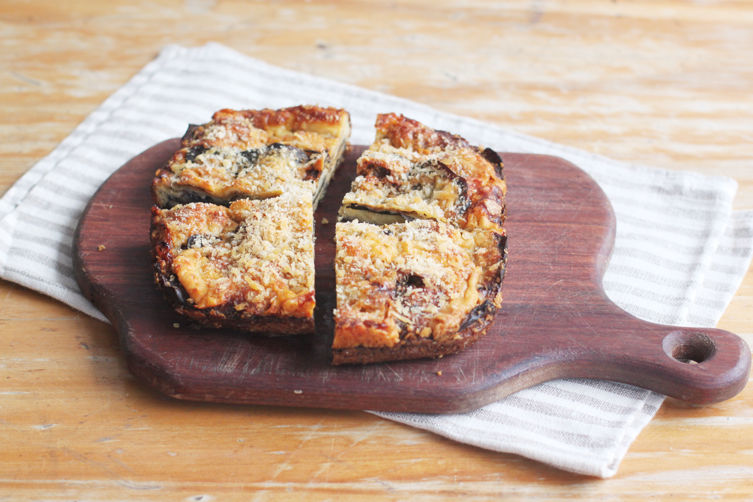
Parmigiana Bianca (“White” Eggplant Parmigiana) from food52.com

parmigiana_food52_IMG_3502_food52


Author Notes:
 This is a version of Eggplant Parmigiana that hails from Puglia, Italy’s heel, called “Parmigiana bianca” or “white Parmigiana”. The main difference is that it’s made without the tomato sauce that is characteristic of traditional Eggplant Parmigiana. The result is a gentler, sweeter version of the classic recipe.

It’s typically served as an antipasto — cut into small pieces and presented alongside a delicious platter of salumi, olives, marinated vegetables, fresh cheeses, and lovely deep-fried things. It also makes for great, portable picnic fare.(less) – Emiko

  • 2 large eggplants
  • Salt
  • Olive oil for frying
  • 4 tablespoons (60 grams) dried breadcrumbs
  • 3 eggs
  • 1/2 cup (125 milliliters) milk
  • 3 ounces (80 grams) Parmesan or pecorino cheese, grated
  • 7 ounces (200 grams) fresh mozzarella (about 1 large ball), provola, or caciocavallo cheese
  1. Cut the eggplant into 1-centimeter slices and sprinkle each with salt on one side. Let sit for at least 30 minutes or up to 8 hours. Rinse and pat the slices dry, then fry them in plenty of olive oil (or grill with a little olive oil) until golden brown and tender. Place the slices on paper towels to drain any excess oil and set aside until needed.
  2. Prepare a casserole dish by greasing it with olive oil and dusting with a tablespoon of the breadcrumbs.
  3. Beat the eggs and milk together with a pinch of salt and half of the Parmesan cheese.
  4. Layer the eggplant in a casserole dish with the mozzarella and a sprinkling of breadcrumbs. Pour the egg mixture over the eggplant and mozzarella. Finish with the rest of the Parmesan and a final sprinkling of breadcrumbs. Bake in the oven at 350º F (180º C) until the eggs are set and the top is golden and crisp, about 15 to 20 minutes. Serve as part of an antipasto.
  5. Serves 4 to 6 as part of an antipasto


Tomato and Cream Cheese Turnovers from food52.com

  • tomato_cheese_turnover_26 ounces cream cheese, at room temperature
  • 2 large eggs (one is for an egg wash)
  • Salt and pepper
  • 2 sheets of all-butter puff pastry dough, defrosted
  • 1 large tomato, sliced in 1/4-inch thick slices
  • 2 tablespoons sesame seeds
  • Flour, for dusting
  1. Heat your oven to 375° F. In a large bowl, beat together the cream cheese and one egg plus a couple pinches of salt and pepper. Beat until smooth.
  2. On a floured surface, roll the first sheet of puff pastry out to about 1/8 inch thick. Cut it into 6 rectangles. Spread some cream cheese mixture on each rectangle and place a bit of tomato on top of the cream cheese. To make more reasonably sized pastries, fold each of the rectangles over their filling and press the edges well with a fork to seal them, then repeat with the next sheet of puff pastry. To make big pastries, put more filling on each of the rectangles, then roll out the next sheet of puff pastry, cut that into 6 rectangles and put one on top of each of the rectangles with filling, then press around the edges with a fork to seal. Transfer the pastries to two baking sheets.
  3. Whisk the second egg with a tiny splash of water, then brush each pastry with some of the egg wash and sprinkle them with sesame seeds.
  4. Bake each sheet of pastries in the oven until golden brown and puffed, about 25 minutes. Remove from the oven and transfer to a cooling rack. Allow to cool slightly before eating, but these guys are definitely best eaten fresh. Otherwise the puff pastry gets a little sad and the tomato gets soggy. Makes 6 very large or 12 more modest pastries


Brownie Puddle from: The Pie and Pastry Bible, Rose Levy Beranbaum

download

1 cup pecan pieces or coarsely chopped pecans (I used 1.5 cups walnuts)
14 tbsps. unsalted butter
3 oz. bittersweet chocolate (I used 3.5 oz. bar of Lindt 70%)
1/2 cup + 2 teas. unsweetened cocoa, preferably fine-quality
Dutch-processed (I used Hershey’s, but it is Dutch-processed)
1 cup + 3 tbsp. sugar
3 large eggs
2 teas. pure vanilla extract
3 oz. cream cheese cut into pieces
1/2 cup all-purpose flour
pinch salt

Ganache Puddle
2/3 of a 3 oz. bar of bittersweet chocolate, coarsely chopped
1/3 cup heavy cream, at room temperature

Equipment:
A 9.5 inch fluted tart pan with a removable bottom, bottom greased, lined with parchment, and then lightly sprayed with nonstick vegetable spray.

Preheat over to 325 degrees at least 15 minutes before bake. Set an oven
rack in the middle of the oven before preheating.

Please the pecans on a cookie sheet and toast them. stirring occasionally,
for about 10 minutes or just until the color deepens slightly. Cool
completely.

In a double boiler over hot water or in microwave-proof bowl, melt the
butter and chocolate, stirring two or three times. If using a double
boiler, transfer the mixture to a bowl.

Beat the cocoa, then the sugar, into the chocolate mixture, beating until
incorporated. (If you are doing this by hand, use a whisk.) Beat in the
eggs and vanilla. When incorporated, beat in the cream cheese until only
small bits remain. Add the flour and salt and mix only until the flour is
fully moistened. Stir in the nuts.

Place the prepared tart pan on a cookie sheet to catch any possible leaks.
Scrape the batter into the pan and spread it evenly. It will fill the pan
almost to the top.

Bake for 30 to 35 minutes or until the batter has set. A toothpick
inserted 1 inch from the side should come out clean. The mixture will puff
and rise a little above the sides but sinks on cooling.

Make the ganache puddle

While the brownie is baking, prepare the puddle. Melt the chocolate in a
double boiler over hot but not simmering water, stirring occasionally, or
in a microwave, using 15 second burst on high power and stirring several
times. Add the cream and stir gently until the mixture is smooth and dark.
If necessary (if the cream was too cold and the mixture is not entirely
smooth), return it to the heat and stir until totally fluid and uniform in
color.

As soon as the brownie is removed from the oven, grease the end of a wooden
spoon (1/2 inch diameter) and insert it into the brownie at 1 inch
intervals, all the way to the bottom, twisting slightly as your insert and
withdraw it to create 23 to 28 little holes. Using a small spoon or a
re-closable freezer bag with a small piece cut off one corner, fill the
holes with the ganache until slightly rounded on top (you will need at
least 1/2 teaspoon for each). Place the pan on a wire rack and cool
completely. The chocolate puddles will sink in as the brownie cools and
more ganache can be added to fill in any depressions as long as the brownie
is still warm enough to melt it. (If necessary, you can set the tart under
a lamp to heat the ganache puddles and make them smooth.)

Unmold the tart, and place it onto a serving plate. To serve, use a thin
sharp knife to cut into wedges. Oven temperature: 325 F
Baking time: 30 to 35 minutes
Serves: 8

Store:  Wrapped tightly in plastic wrap and stored in an airtight container room temperature, up to 1 week; refrigerated, up to 1 month; frozen, several
months. Try it frozen or chilled if you like a chewy brownies, at room temperature for a softer creamier texture.

CARAMEL VARIATION: Caramel blends perfectly with the chocolate and pecans and is wonderful both at room temperature and refrigerated, when it becomes more sticky and chewy. Make a half recipe of the Caramel Sauce and use it in place of the chocolate puddle glaze. It is easiest to pipe it into the holes. The caramel will pipe when warm or at room temperature.