Mushroom Ragoût from nytimes

  • 1 ounce (abo16recipehealth-articleLargeut 1 cup) dried mushrooms, preferably porcinis
  • 2 tablespoons extra virgin olive oil
  • 2 shallots or 1/2 medium onion, finely chopped
  • 2 garlic cloves, minced
  • 1 pound white or cremini mushrooms, cleaned, trimmed, and quartered or sliced 1/2 inch thick
  • 1 pound wild mushrooms, trimmed and brushed clean, or oyster mushrooms, trimmed and torn into pieces if very large
  •   Salt to taste
  • 2 teaspoons all-purpose flour
  • ½ cup dry white wine such as sauvignon blanc or pinot grigio
  • 2 teaspoons chopped fresh rosemaryor 1 teaspoon dried
  • 2 teaspoons chopped fresh thyme
  •   Freshly ground pepper
  • 2 to 4 tablespoons finely chopped flat-leaf parsley
  1. Place the dried mushrooms in a pyrex measuring cup or a bowl and pour on 2 cups boiling water. Let soak 30 minutes, while you prepare the other ingredients. Place a strainer over a bowl, line it with cheesecloth or paper towels, and drain the mushrooms. Squeeze the mushrooms over the strainer and rinse until they are free of sand. Chop coarsely.
  2. Heat the olive oilover medium heat in a large, heavy skillet or a wide saucepan and add the shallots or onion. Cook, stirring often, until tender, 3 to 5 minutes. Add the garlic, stir together for about 30 seconds, until fragrant, then add the fresh mushrooms, rosemary and thyme, and turn up the heat slightly. Cook until the mushrooms begin to sweat, then add a generous pinch of salt. Stir for about 5 minutes over medium-high heat as the mushrooms continue to soften and sweat. Add the flour and continue to cook the mushrooms, stirring, until they have softened a little more and you can no longer see the flour, about 2 minutes. Add the reconstituted dried mushrooms and the wine and turn the heat to high. Cook, stirring, until the liquid boils down and glazes the mushrooms, about 5 minutes. Stir in the dried mushroom soaking liquid, bring to a simmer, add salt to taste, and cook over medium-high heat, stirring often, until the mushrooms are thoroughly tender and fragrant and the surrounding broth is thick, about 10 to 15 minutes. Remove from the heat, stir in some freshly ground pepper and the parsley, taste and adjust salt.

NOTE

  • Advance preparation: The ragoût can be made up to 3 or 4 days before you wish to serve it. Keep in the refrigerator. Reheat gently on top of the stove.


Caramel Sauce by Rose Levy Beranbaum The Pie and Pastry Bible

This sauce is for the caramel lover. It’s equally wonderful over ice cream, cake, or apple pie. It is just thick enough when hot, but not clumpy or sticky as it cools on the plate. Don’t be afraid of making caramel. If you follow the simple but important Pointers for Success below, it will be easy. Do be sure when making it not to have any small children about and give it your undivided attention. Caramel burns are extremely painful.
download (1)
1 cup sugar (7 ounces = 200 grams)
1 tablespoon Lyle’s Golden Syrup (refiner’s syrup) or corn syrup (0.75 ounce = 21 grams)
1/4 liquid cup water (2 ounces = 60 grams)
1/2 liquid cup heavy cream, heated (4 ounces = 116 grams)
2 tablespoons unsalted butter, softened (1 ounce = 28 grams)
1 teaspoon pure vanilla extract

EQUIPMENT
A heavy saucepan, at least 5-cup capacity, ideally with a nonstick lining

In the saucepan, stir together the sugar, syrup, and water until the sugar is completely moistened. Heat, stirring constantly, until the sugar dissolves and the syrup is bubbling. Stop stirring completely and allow it to boil undisturbed until it turns a deep amber (380°F.). Immediately remove it from the heat and slowly and carefully pour the hot cream into the caramel. It will bubble up furiously.

Use a high-temperature heat-resistant rubber spatula, or a porcelain or wooden spoon to stir the mixture until smooth, scraping up the thicker part that settles on the bottom. If any lumps develop, return the pan to the heat and stir until they dissolve. Stir in the butter. The mixture will be streaky but become uniform after cooling slightly and stirring.

Allow the sauce to cool for 3 minutes. Gently stir in the vanilla extract.

For a decorative lacing effect, this caramel pours perfectly at room temperature. For the greatest precision, use a pastry bag with a small decorating tube or a reclosable bag with a small piece cut from one corner.

STORE
Room temperature, up to 3 days; refrigerated, at least 3 months. To reheat: If the caramel is in a microwave-safe container at room temperature, microwave it on high power for 1 minute, stirring twice. If cold, it will take a few seconds more. Alternatively, place it in a bowl in a pan of simmering water and heat, stirring occasionally, until warm, about 7 minutes.

Understanding
Refiner’s or corn syrup helps to prevent the caramel sauce from crystallizing when stirred. It also lowers the caramelization temperature.

I adore the flavor of caramel, so I like to have as much depth of flavor as possible without any burnt flavor. I bring this caramel up to at least 380°F. for maximum flavor. The darker you make the caramel, the less sweet it will seem, but you risk burning it if you don’t have an absolutely accurate thermometer.

It’s best to have the cream hot and the butter at room temperature to avoid splattering when they are added to the hot caramel. Cold cream, however, speeds the cooling and is practical if you’re pressured for time — but it must be added very slowly.

I do not recommend using crème fraîche in place of heavy cream, as it does not decrease sweetness to any significant degree nor does it add interest of flavor.

Unrefined sugar, which contains a small amount of natural molasses — which caramelizes at a slightly lower temperature — provides a flavor that is deliciously reminiscent of butterscotch. The “impurities” in unrefined sugar can cause crysallization so if you use it, care must be taken not to stir the caramel too much.

Pointers for Success
• Most important: When making caramel, be careful to concentrate every moment. Sugar burns are extremely painful.

• Use refined sugar that is absolutely free of impurities, to prevent crystallization.

• To further prevent crystallization, do not allow any sugar crystals to get on the sides of the pan, and be sure to moisten all the sugar with the water. Stop stirring entirely as soon as it comes to a boil. If using a thermometer, be sure to rinse it and dry it if removing and reinserting in the syrup. If any sugar remains on the thermometer, it will cause crystallization.

• Use a pan that conducts heat well (such as unlined copper, aluminum, or anodized aluminum) so that cooking stops soon after it is removed from the heat. Alternatively, have ready a larger pan or sink partly filled with cold water to immerse the bottom of the pan. Do not use a pan with a tin or nonstick lining, as its melting point is below that of caramel.*

• To determine the color of the caramel, use an accurate thermometer or drop a bit of caramel on a white surface such as a porcelain spoon or plate. When making spun sugar, too light a caramel produces a ghostly effect, too dark produces a brassy color when spun.

• To prevent breakage, never put a thermometer used for caramel into water until completely cooled.

• Soaking utensils in hot water will remove hardened caramel.

• After the caramel is prepared, do not stir it too much, as this may eventually cause crystallization.

*There are some special pans, such as the Scanpan, from Denmark, with nonstick properties that can withstand the heat of caramel.

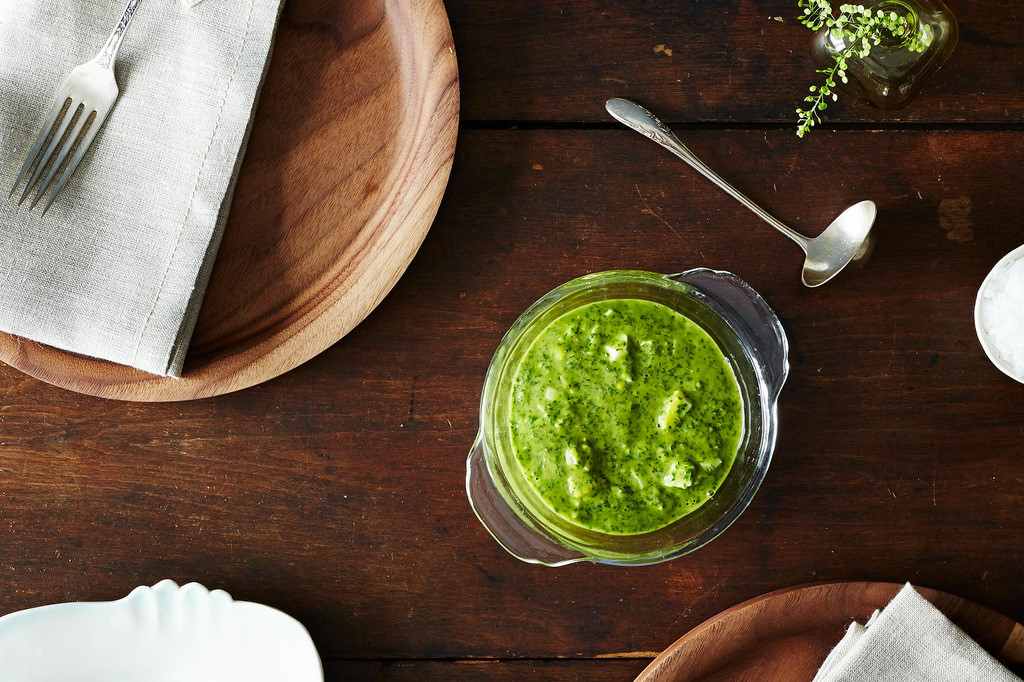
The Silver Palate’s Green Sauce

13876806924_df831ed5d3_b

  • cups fresh parsley leaves
  • scallions (green onions, white and green parts), sliced
  • 1/2 cup fresh dill sprigs
  • anchovy fillets, drained
  • cloves garlic, roughly chopped
  • tablespoon capers, drained
  • 6t ablespoons fresh lemon juice
  • 3/4 cups olive oil
  • Salt and freshly ground black pepper, to taste
  • hard-cooked eggs, finely chopped
  1. Mince the parsley, scallions, and dill in a food processor fitted with a steel blade. Add the anchovies, garlic, capers, and lemon juice. Process until smooth. With the machine running, add the oil in a thin, steady stream. Season to taste with salt and pepper. Remove to a serving bowl and stir in the eggs. Makes 1 1/2 cups

A sauce in spring green that goes with everything from asparagus to salmon to Easter hams and lambs (and the perfect place to put those leftover hard-boiled eggs). Adapted slightly from The Silver Palate Good Times Cookbook

Make a huge batch on Easter. Set it out on the table with your lamb or ham. The next day, spoon it over poached salmon. Bundle boiled new potatoes all up in it, then take them to work with you. Pool it on top of grilled chicken, or shrimp, or steak. Dunk spears of blanched asparagus. And radishes. And fennel.

There’s almost nothing you will cook for dinner this season (or the next) that you won’t want to cover in green sauce.


Chile Sauce from Everyday Food with Sarah Carey

download
5 ancho chiles, stemmed and seeded
4 jalapenos, stemmed, seeded, and quartered
4 garlic cloves, roughly chopped
4 tablespoons dark-brown sugar
3 tablespoons unsulfured molasses
3/4 cup ketchup
1/3 cup cider vinegar
1/2 cup fresh orange juice
Coarse salt and ground pepper

In a small saucepan over medium-high, cover ancho chiles with water and simmer until chiles are soft, 5 to 6 minutes. Drain and transfer to a blender with jalapenos, garlic, sugar, molasses, ketchup, vinegar, and orange juice. Blend until mixture is smooth and season to taste with salt and pepper.

COOK’S NOTE:  To store, refrigerate in an airtight container, up to 5 days.

Guasacaca sauce from Margaret L

1 onion, peeled, base removed and cut into eighths
1 ripe avocado, peeled and pitted
2-3 tablespoons of white or rice wine vinegar
2-3 cloves of garlic
1 jalapeño pepper, seeded and cored
1 bunch flat leaf parsley, washed and mostly dried
1 bunch cilantro, washed and mostly dried
salt to taste
3 tbsp vegetable oil

Place the onion, avocado, vinegar, garlic, and jalapeño in a blender (or food processor)
and purée until smooth. Add the parsley and cilantro and purée until smooth. If it is too
dry and won’t blend, add a little vinegar.
Add salt to taste and then add the oil last.

Use on meat, fish, poultry, refritos or even bread. I found it as an accompaniment to Venezuelan arepas. Freeze excess. Margaret L

Thousand Island Dressing

use the following ingredients as a guide
1/2 cup mayonnaise or veganaise
2 tablespoons ketchup
1 tablespoon rice wine vinegar
2 teaspoons sugar
2 teaspoons sweet pickle relish
1/8 teaspoon salt
1 dash black pepper

Combine all of the ingredients in a small bowl. Stir well.

Place dressing in a covered container and refrigerate for several hours, stirring occasionally, so that the sugar dissolves and the flavors blend.

Read more: http://www.food.com/recipe/thousand-island-dressing-100355?oc=linkback

Salad Dressing by Phyllis

3 Tbsp. seasoned rice vinegar
1 clove garlic minced
1/2 tsp. kosher salt
1 Tbsp. soy sauce
1 Tbsp. Honey
1/4 tsp. roasted sesame oil, optional ( I used it)
1/3 cup vegetable oil

I put it all into a small jar and mixed it up…I tossed it onto Romain lettuce, diced red onion, and sliced celery!! YUMskies!!

Korean Seasoned Dipping Sauce (Yangnyeom Ganjang)

Korean Fried Dumplings (Goon Mandu)
1/2 cup low-sodium soy sauce
1/2 teaspoon Korean sesame oil (see headnote)
1 teaspoon crushed, toasted sesame seeds (see headnote)
1 scallion, trimmed and cut crosswise into very thin slices
2 cloves garlic, minced
1/4 teaspoon sugar
1/4 teaspoon ground black pepper
1/2 to 1 teaspoon Korean hot red chili powder (gochugaru; optional)

This salty sauce provides the right counterpoint to mildly seasoned dumplings. Give the sauce a few minutes to meld before serving.

You’ll want to double the recipe if you serve this as the sole condiment for Korean fried dumplings. The sauce can be refrigerated for up to 3 days.

makes 2/3 cup